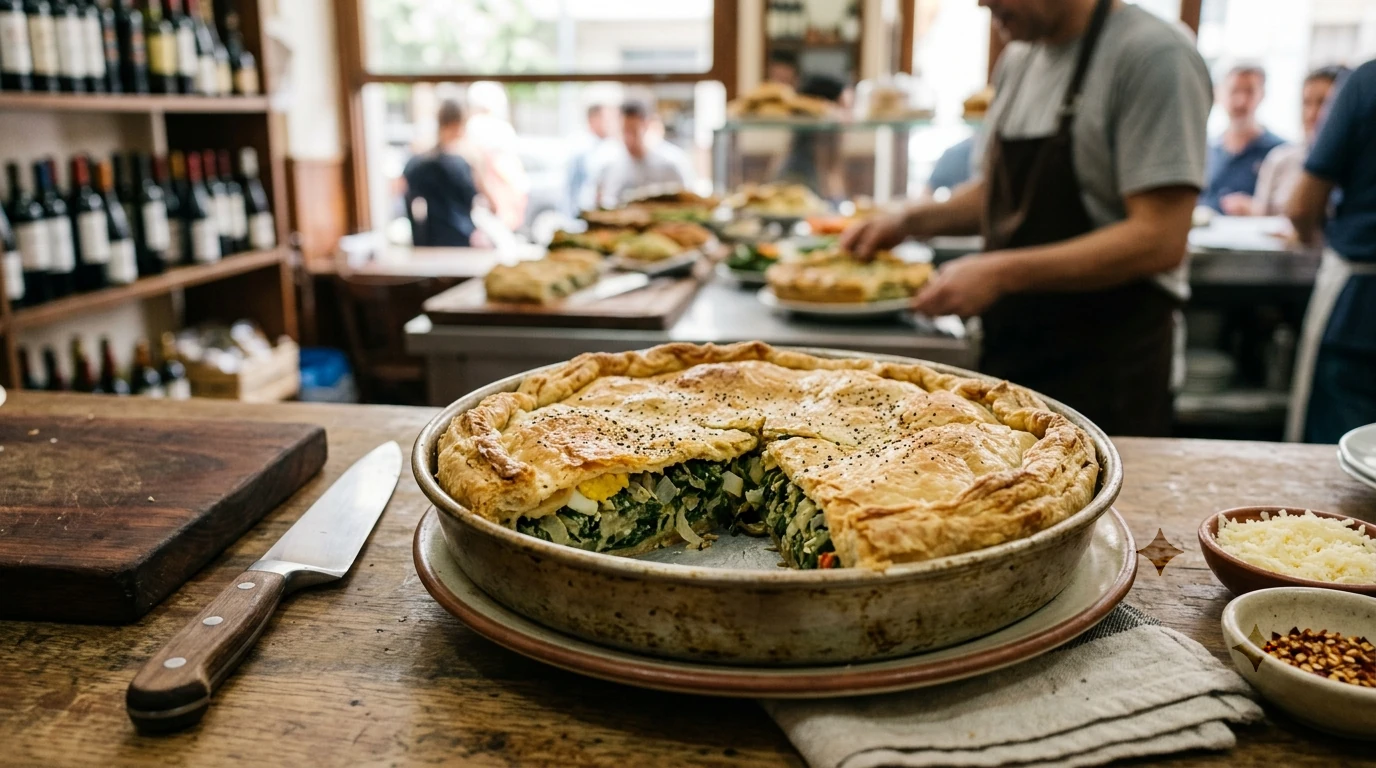
A search for the best tarta de acelga near me sounds simple: find a nearby bakery, compare a few ratings, and order the best-looking slice. In practice, the search is harder because many restaurants don’t use the Spanish name, delivery apps change results by address, and closely related dishes such as spinach fatayer, quiche, spanakopita, and vegetable pie can appear as false matches.
For readers in Karachi, the clearest verified answer as of July 15, 2026, is that no restaurant or bakery could be confirmed as publicly listing an authentic tarta de acelga by name. Square at Mont Vista offers the nearest documented alternative: a Rs. 149 fatayer that may be filled with spinach, cheese, or meat. It may satisfy the craving for greens inside baked dough, but it is not the same dish, and the filling should be confirmed before ordering.
That does not mean tarta de acelga is unavailable. It may be sold by home cooks, private caterers, or small food businesses whose menus are shared through WhatsApp or social media rather than indexed online. The best route is to search under several names, ask precise questions about the filling and pastry, and consider a custom order or homemade version when an exact local listing cannot be found.
What Tarta de Acelga Is
Tarta de acelga is a savory tart filled mainly with Swiss chard, known as acelga in Spanish. The cooked greens are usually combined with onion, eggs, cheese, black pepper, and sometimes nutmeg before being baked inside pastry. Depending on the recipe, the tart may have a single bottom crust or a pastry lid that fully encloses the filling.
The balance of ingredients matters. A good version tastes first of leafy greens, with onion adding sweetness and cheese adding salt and richness. Egg acts as a binder, but the interior should not resemble a dense omelet or a soft cream-heavy custard.
Recipes vary across families and countries. Some use ricotta, mozzarella, Parmesan, or a mild fresh cheese. Others include whole eggs baked into the filling, creating the distinctive white-and-yellow cross-section associated with pascualina.
Swiss chard has broad leaves and firm stalks, giving the tart a slightly more substantial texture than spinach. Where chard is difficult to find, spinach is a common substitute. In Karachi, palak is the most practical alternative, although the final flavor will be milder and the leaves will soften more quickly during cooking.
How it differs from pascualina
Tarta de acelga and pascualina are closely related, and their names are sometimes used for the same dish. Pascualina usually refers to a closed greens pie descended from the Ligurian torta pasqualina. Whole eggs baked into hollows in the filling are one of its most recognizable features.
A simpler tarta de acelga may use beaten egg only, omit the pastry lid, or contain a thinner layer of filling. Naming differs between restaurants, countries, and home kitchens, so a menu title alone does not always reveal the exact preparation.
Searches should include pascualina, tarta pascualina, tarta de verdura, and Swiss chard pie. A seller may prepare the right dish without using the phrase tarta de acelga.
How it differs from quiche
Quiche is built around a liquid mixture of eggs and milk or cream. Vegetables, meat, or cheese are suspended in that custard, which sets into a soft, fairly uniform filling.
Tarta de acelga reverses that ratio. Chard or spinach makes up most of the interior, while the eggs and cheese hold the greens together. A cut slice should show chopped leaves, onion, and pieces of cheese rather than a smooth yellow center.
How it differs from spinach fatayer
Spinach fatayer is a Middle Eastern hand pie, often made with a soft bread-like dough. Its filling may include spinach, onion, lemon, sumac, or pomegranate molasses, giving it a sharper and more acidic taste.
Tarta de acelga is usually baked as one larger pie and cut into slices. Its filling tends to be softer, richer, and more strongly bound by eggs and cheese. Fatayer is a useful local substitute, but it should not be presented as an exact match.
The Best Verified Local Option in Karachi
The closest publicly listed option found in Karachi is the fatayer sold by Square at Mont Vista. The menu lists the pastry at Rs. 149 and describes possible fillings that include spinach, cheese, or meat. Because the published listing does not guarantee which filling is available at a given time, customers should ask before placing an order.
Square at Mont Vista is listed on the third floor of Mont Vista Chase Up. Its posted hours run from 11 a.m. to 10:30 p.m. on most days, with Friday service beginning at 3 p.m. These details can change, so they should be checked through the current ordering platform before travel or pickup.
This option makes sense for someone seeking an inexpensive savory pastry with greens. It does not meet the full definition of tarta de acelga because it is an individual Middle Eastern pastry rather than a large South American-style tart. The seasoning, dough, and filling structure are also likely to differ.
Other Karachi bakery results are less relevant. Pie in the Sky has listed an empanada filled with chicken, black olives, and salsa, which is clearly not a vegetarian chard tart. PAUL’s Karachi menu includes breads, pastries, sandwiches, salads, pasta, and breakfast items, but no verified tarta de acelga or spinach quiche appeared in the researched menu material.
The absence of a confirmed listing should not be mistaken for proof that the dish is never made in the city. Small caterers and home chefs often accept custom requests without maintaining searchable websites. A private seller may also rotate dishes weekly, making an older post a poor guide to current availability.
How to Find a Better Match Near You
A good local search begins with the right vocabulary. Searching only for “tarta de acelga” may miss businesses that call the dish pascualina, vegetable tart, Swiss chard pie, spinach ricotta pie, or Argentine spinach pie. Adding the city name, neighborhood, or delivery area can narrow the results.
Delivery apps should be searched after setting an exact address. Platforms such as Foodpanda change restaurant visibility according to distance, branch hours, stock, and delivery coverage. Two people in different parts of Karachi may see entirely different menus from the same search phrase.
Social media can reveal businesses that search engines miss, but photographs require careful reading. A glossy picture of an intact pastry does not show whether the filling is mostly greens, mostly cheese, or something else entirely. A recent image of a cut slice is far more useful.
Before ordering, ask the seller whether the filling contains Swiss chard, spinach, or both. Confirm whether the pie has one crust or two, whether the cheese is ricotta, mozzarella, feta, Parmesan, or another variety, and whether eggs are mixed through the filling or baked whole inside it.
The baking date also matters. A freshly made tart can be held and reheated successfully, but pastry loses crispness when it sits too long in a moist container. A seller should be able to say whether the tart will be baked on the day of delivery or supplied from frozen stock.
Size descriptions can be misleading. “Medium” and “family size” mean little without a diameter, finished weight, or portion estimate. A tart measuring about 23 to 25 centimetres across usually provides six substantial slices or eight lighter servings, depending on its depth.
How to Judge the Quality of Tarta de Acelga
The crust gives the first clear signal. It should be browned, dry on the surface, and firm enough to support the filling when sliced. A pale or gummy base often means the vegetables were not drained properly or the tart was removed from the oven too early.
The filling should be moist without releasing water onto the plate. Both Swiss chard and spinach hold a large amount of liquid, and cooking draws even more of it out. The greens must be cooled and pressed thoroughly before they are mixed with the remaining ingredients.
Texture should remain visible. The leaves may be chopped finely, but they should not be blended into a uniform paste. Onion should be soft, and any pieces of chard stalk should be tender enough to cut easily with a fork.
Cheese should support the greens rather than bury them. Ricotta creates a soft, mild filling, mozzarella adds stretch, and Parmesan adds concentrated salt and savoriness. Feta can work, but it moves the flavor closer to Greek-style spinach pie.
Nutmeg is traditional in many versions, yet only a small amount is needed. Too much can make the filling taste medicinal or sweet. Black pepper, onion, and restrained seasoning usually allow the chard to remain the main flavor.
The tart should also hold its shape. A filling that pours out may contain too little egg, too much vegetable liquid, or may have been cut before it rested. A hard, rubbery interior points to excess egg or overbaking.
Cost, Ordering, and Homemade Alternatives
There is no verified public Karachi price for a complete tarta de acelga. The Rs. 149 fatayer at Square at Mont Vista provides a reference for a small individual pastry, but a whole custom tart will cost much more because it uses larger quantities of greens, eggs, cheese, and pastry.
Recent online grocery listings used in the earlier research placed 500 grams of palak at about Rs. 59.40, a dozen standard eggs at roughly Rs. 325, 400 grams of prepared puff pastry at Rs. 250, and 200 grams of shredded cheese between about Rs. 565 and Rs. 750. Prices can change by store, brand, and delivery area.
A basic homemade tart using half a dozen eggs, one pastry pack, 500 grams of greens, and 200 grams of cheese would place those main ingredients at roughly Rs. 1,040 to Rs. 1,225. Onion, oil, seasoning, electricity, packaging, and labor would add to the total.
That estimate helps explain why a proper custom pie should not be compared with the price of two or three bakery patties. Cheese is likely to be the largest variable. A seller using imported ricotta or Parmesan will have a higher ingredient cost than one using local mozzarella or a mild white cheese.
Making a practical version with palak
A 23- to 25-centimetre tart can be made with 500 to 700 grams of cleaned palak or Swiss chard, one large onion, four or five eggs, 150 to 200 grams of cheese, and enough pastry for a base and lid. Black pepper, salt, and a small pinch of nutmeg are usually sufficient.
The greens should be washed, cooked until wilted, cooled, and pressed firmly in a colander. Chard stalks can be included, but they need to be chopped more finely and cooked slightly longer than the leaves. Removing water is the most important step in protecting the bottom crust.
The drained greens can then be mixed with softened onion, two beaten eggs, most of the cheese, and seasoning. For a pascualina-style result, small hollows can be made in the filling and raw eggs cracked into them before the pastry lid is added. Chopped hard-boiled eggs provide a more predictable result and make serving easier.
Bake the tart at about 180°C to 190°C until the top and bottom are browned and the filling is set, usually for 35 to 45 minutes. The exact time depends on the oven, pastry thickness, and pan material. Let the tart rest for at least 15 minutes before cutting so the filling can firm.
Storage, Safety, and Dietary Considerations
Tarta de acelga contains cooked vegetables, eggs, and usually dairy, so it should be treated as a perishable dish. It should not remain at room temperature for more than two hours. In temperatures above 32°C, that window falls to one hour.
Leftovers should be cooled promptly and stored in a covered container in the refrigerator. Standard food-safety guidance for cooked egg dishes and quiche allows three to four days of refrigerated storage. A refrigerator temperature of 4°C or below is the safer target.
Slices can be frozen, although the texture may change. The vegetables may release water during thawing, and the pastry may become softer. Reheating in an oven or toaster oven gives a better crust than microwaving.
The standard recipe is vegetarian but not vegan. It normally contains eggs and cheese, and the pastry may include butter or another animal fat. Anyone avoiding animal products should ask for the full ingredient list rather than relying on the word “vegetable.”
The main common allergens are wheat, egg, and dairy. Gluten-free or vegan versions can be made, but they will not behave exactly like the traditional tart. Gluten-free pastry may crumble more easily, while an egg-free filling needs another binder to keep the slices intact.
Common Misunderstandings
The first misunderstanding is that every spinach pie is a form of tarta de acelga. Spinach pie is a broad description that can refer to fatayer, spanakopita, quiche, börek, puff pastry rolls, or a large vegetable tart. The filling and pastry style must be checked.
Another mistake is assuming that an Argentine or Latin American restaurant will automatically sell the dish. Tarta de acelga is common home food in parts of South America, but it may not appear on every restaurant menu. A general cuisine label is not proof of availability.
Ratings can also mislead. A bakery may have strong reviews for cakes, bread, or chicken patties without any record of making a good vegetable tart. Reviews tied to the exact item are more useful than a high overall score.
Some buyers also confuse freshness with serving temperature. Tarta de acelga does not need to arrive blistering hot to be good. It can be served warm or at room temperature, provided it has been stored safely and the pastry has not become damp.
Home cooks often focus on expensive cheese while overlooking the condition of the greens. Fresh leaves, well-cooked onion, and thorough draining affect the result more than using a premium cheese. A modest cheese used carefully can produce a better tart than an expensive one added in excess.
Frequently Asked Questions
Where can I find the best tarta de acelga near me in Karachi?
No Karachi restaurant or bakery was publicly confirmed as listing authentic tarta de acelga by name as of July 15, 2026. Square at Mont Vista offers the closest verified alternative, a Rs. 149 fatayer that may be available with spinach, cheese, or meat filling.
A custom order from a home chef or caterer may provide a closer match. Ask for a recent photo of the cut tart and a complete ingredient description before ordering.
Is tarta de acelga the same as spinach pie?
Not exactly. Tarta de acelga traditionally uses Swiss chard, although spinach is often substituted where chard is unavailable.
The phrase “spinach pie” can also describe several unrelated dishes. Ask whether the filling contains eggs and cheese and whether it is baked as a large tart or an individual hand pie.
Is pascualina the same dish?
Pascualina is a close relative and may be sold under the same name as tarta de acelga. It usually has a pastry lid and often contains whole eggs baked into the greens.
A simpler tarta de acelga may use only a bottom crust or mix beaten egg through the filling. The distinction varies by region and family tradition.
Can I use palak instead of Swiss chard?
Yes. Palak is the most accessible Karachi substitute and works well with the same basic method.
It cooks faster and has softer stems than chard. Drain it thoroughly because excess moisture can make the pastry base soggy.
Is tarta de acelga healthy?
It can provide a substantial serving of leafy greens and protein from eggs and cheese. Its calorie and fat content depend heavily on the pastry, cheese, and portion size.
A tart made with puff pastry and full-fat cheese can be rich. A thinner crust, moderate cheese, and a high proportion of greens produce a lighter result.
How long does tarta de acelga keep?
A refrigerated tart should generally be eaten within three to four days. Store it covered at 4°C or below and avoid leaving it at room temperature for extended periods.
It can also be frozen, though the crust may soften after thawing. Reheating in an oven gives the best texture.
Can I order it for a vegetarian gathering?
Yes, provided the seller confirms that the tart contains no meat, meat stock, or animal-based pastry fat that conflicts with your guests’ preferences. Eggs and dairy are present in most standard versions.
For a mixed gathering, ask for the tart’s diameter and expected number of servings. A medium whole tart commonly provides six main portions or eight smaller slices.
Conclusion
Finding the best tarta de acelga near you depends less on discovering a perfect search result and more on identifying the dish correctly. In Karachi, no exact public listing was confirmed, while the nearest documented substitute is a spinach-capable fatayer rather than a South American chard tart.
A good seller should be able to explain the greens, cheese, eggs, crust, size, and baking date. Those details are more useful than a generic menu description or a collection of unrelated bakery ratings.
Where a verified local version is unavailable, a custom order is the strongest next step. A capable savory baker can reproduce the dish with chard or palak if given a clear description and enough notice.
The main standard is simple: plenty of well-drained greens, restrained cheese, properly cooked egg, and pastry that remains crisp enough to hold a slice. Whether bought from a local cook or baked at home, that balance is what turns an ordinary spinach pie into a convincing tarta de acelga.